



Agentic AI enterprise platforms are quickly maturing from experimentation to production-grade systems. Platforms are no longer just systems of record, but execution environments that enable autonomous agents to reason, act, and coordinate workflows.
This transition is fueling a wider enterprise AI transformation, as companies are reimagining their architecture, data flows, and operational models, not just their tools. While efficiency is still a key consideration, the emphasis is now on creating systems that can perform work end-to-end.
In many instances, organizations will start this transformation journey by hiring an Agentic AI development company or by leveraging Agentic AI development services, but the true success comes from a more fundamental redesign of the structure.
Table of Contents
Enterprise Platforms Are Evolving Into Autonomous Execution Layers
Enterprise platforms are no longer just data storage and retrieval systems. They are becoming execution layers with autonomous enterprise systems that enable agents to initiate actions and execute workflows.
This transformation is impacting the way platforms such as ERP and CRM operate in real-world environments.
The transition involves several structural changes:
- The development of enterprise platforms as execution-first systems, with agents able to start and end workflows without human involvement, is enhancing operational speed and responsiveness.
- Business applications are embedding AI features that enable decision-making logic to be embedded within the platform layers rather than being dealt with outside the platform.
- Businesses are investing in custom Agentic AI solutions to integrate intelligence into their enterprise processes rather than using external automation solutions.
- Platform design is shifting from interaction-based to outcome-based execution, with success defined by completed actions, not system interactions.
- With the evolution of platforms, organizations are increasingly seeking Agentic AI consulting services to redesign their operational models to support autonomous execution.
The Shift From Static Workflows To Adaptive Intelligent Systems
Agentic systems add adaptability to traditional enterprise platforms, with processes changing dynamically as conditions change in real time.
This is where Agentic AI orchestration frameworks come into play, allowing for the coordination of multiple agents working across various systems.
Some of the workflow behavior changes are:
- The way workflows are executed is changing from a linear, step-by-step process to an adaptive process that adjusts to real-time business conditions and data signals.
- Agents are helping platforms to automatically respond to exceptions, minimizing manual escalation and approval processes.
- Business logic is being placed more and more within orchestration layers, not hardcoded into application workflows.
- Event-based systems are being phased out in favor of continuous execution models, where platforms can run without explicit triggers.
- To facilitate this transformation, businesses frequently collaborate with teams that provide Agentic AI solutions to rethink the logic of workflows for adaptive execution.
Platform Integration Is Built on a Multi-Agent Architecture
Enterprise platforms are increasingly moving toward distributed intelligence models, with multiple agents operating together across systems, instead of working independently.
This is where enterprise AI transformation becomes tangible in real-world applications.
The integration approach is changing in several ways:
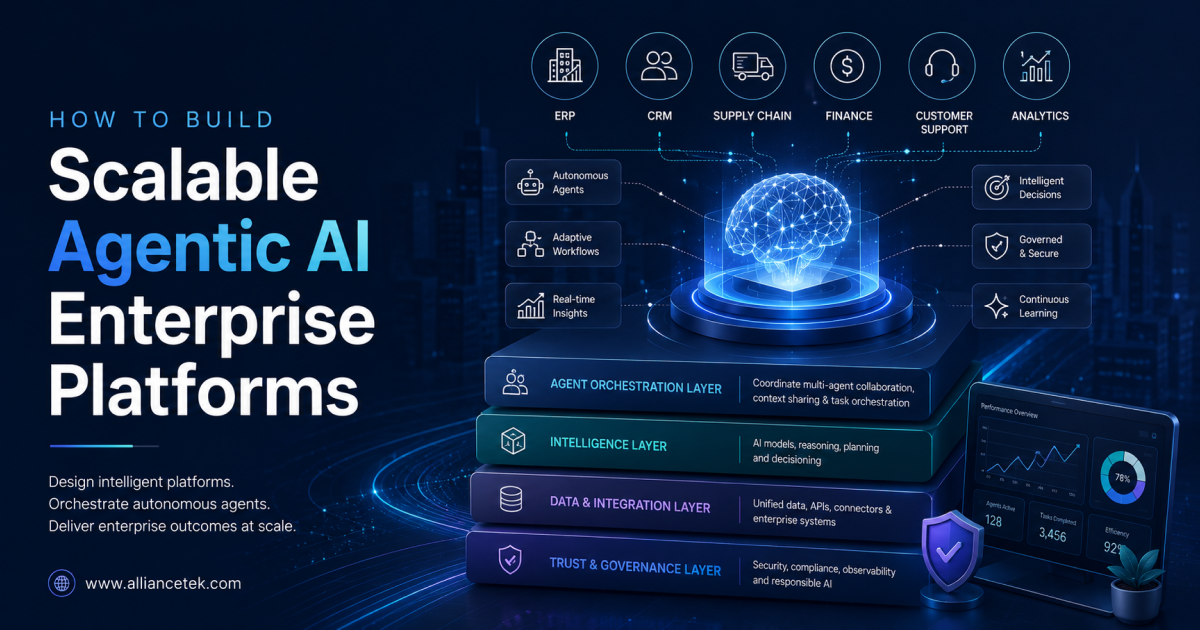
- Many agents are being deployed in enterprise systems like finance, supply chain, and customer operations, allowing for cross-functional automation at scale.
- Agents interact with each other via orchestration layers that enable them to share context, partition tasks, and run workflows together.
- Platforms are exposing structured interfaces that enable agents to communicate with core systems without manual interaction or human-initiated APIs.
- Enterprise architectures are evolving to become more modular, with agents being added to a specific capability without having to rebuild the entire system.
- Companies creating these systems often hire Agentic AI developers to expedite the process.
Data Architecture Is The Key To Agent Effectiveness
Data infrastructure is a key factor in the success of agentic systems in enterprise platforms.
Even the most sophisticated agents can’t work properly without well-organized data.
The most important architectural changes are:
- The information within the enterprise is being organized into layers of context to support reasoning, rather than just retrieval, to improve agent decision quality.
- Traditional ETL systems are being replaced by real-time data pipelines to enable continuous execution models.
- Semantic indexing is being added to enable agents to understand meaning rather than values.
- Data systems are shifting to architectures that are always on and enable constant agent interaction.
- When organizations are modernizing their data systems, they may need to hire remote Agentic AI developers or hire offshore Agentic AI developers to create scalable pipelines for their agents.
Governance Is Becoming A Native Platform Capability
Governance is no longer an external control layer as enterprise platforms become more autonomous. It needs to be integrated into the platform architecture.
Some of the key governance changes are:
- Platforms are developing inbuilt control layers that specify the actions agents can take under certain conditions and constraints.
- Audit systems are changing to monitor multiple agent decision chains rather than individual user decisions.
- Machine identity systems are being added to provide traceability and accountability for all agent actions.
- Governance models are evolving from periodic review to continuous monitoring models that are integrated into execution pipelines.
- Even the best custom Agentic AI solutions can be a source of operational risk if governance is not robust.
Legacy Systems Remain The Primary Barrier To Agentic Scale
While there is a lot of innovation, legacy infrastructure is still holding back agentic adoption in enterprises. These systems were not designed to be autonomous decision makers or to be operated on a continuous basis.
This results in a mismatch between modern agent capabilities and traditional system constraints.
Key limitations include:
- Legacy enterprise systems are based on tightly coupled architectures, which do not allow agents to run cross-system workflows without significant integration.
- Identity systems are not easily extensible to support long-lived machine identities for autonomous agents and are designed for human users.
- Most data pipelines are batch-based, and this is not as responsive as real-time data would be for intelligent workflow automation.
- Integration layers use static APIs, which are not appropriate for dynamic agent-to-agent communication patterns.
- Despite investing in hiring a dedicated Agentic AI developer team, legacy architecture can still affect the scalability of agentic systems.
The Core Platform Layer Is Becoming Multi-Agent Orchestration
Enabling coordinated agent ecosystems is emerging as a crucial feature of contemporary enterprise platforms, beyond AI functionality.
This is where AI orchestration frameworks are the pillars of enterprise architecture.
How orchestration is changing:
- Modular scalability is achieved by specialized agents performing specific tasks such as reasoning, validation, retrieval, and execution.
- Agents interact with each other using standardized protocols that enable smooth integration between systems and platforms.
- Complex workflows are broken down into smaller tasks, and then multiple agents perform these tasks in parallel, improving the efficiency and resilience of the system.
- System failures are isolated and do not lead to complete system failures.
- This orchestration layer acts as the “operational backbone” of autonomous enterprise systems.
The Transition From Software To Outcomes Is In Progress In Enterprise Value
Platforms are evolving, and organizations are no longer evaluating systems based on features or usage, but on measurable business outcomes delivered by autonomous execution.
This transition is a key part of enterprise AI transformation strategies.
The most important changes in the measurement of value are:
- The speed of enterprise platforms to complete workflows is now the measure of their value, not the number of features they offer.
- Success is defined by cycle time reduction, decision speed, and execution efficiency.
- Organizations are focusing on platforms that minimize reliance on manual processes and boost automation precision.
- ROI is becoming more closely associated with independent task completion than with software adoption.
- AI/ML consulting services are often engaged by businesses to make sure that the platform’s capabilities are optimized for real-world business outcomes.
Conclusion
Agentic AI is revolutionizing enterprise platforms from mere systems to intelligent, adaptive execution environments. It’s not just a technological shift; it’s an architectural and operational shift.
Organizations are operating at scale with autonomous enterprise systems, and AI orchestration frameworks and intelligent workflow automation are changing the way they do business.
Companies that prioritize Agentic AI development company partnerships, adopt modern data architecture, and implement robust governance structures will be better equipped to thrive in this transformation. Last but not least, enterprise platforms are not only facilitating business processes, but they are actually executing them.